Book Report: “Hopeful Pessimism” (Mara van der Lugt)
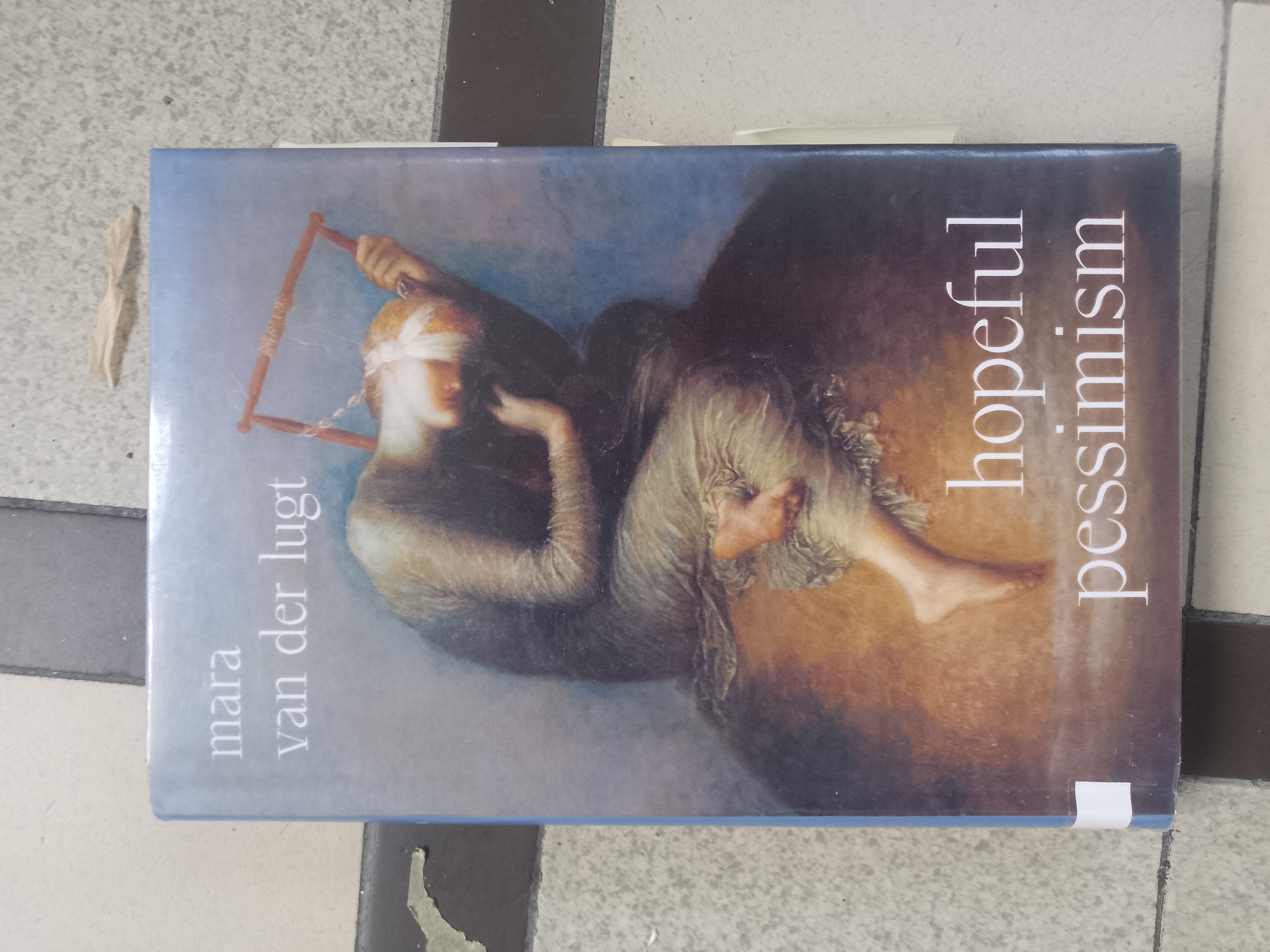
What is hope? Is it the belief in a better future? I am glad to have read the book “Hopeful Pessimism” by Mara van der Lugt. Published in 2025, it has helped me better understand my pessimism, my hope, and what truly drives me.
Pessimism should not be something to be ashamed of. Although we often perceive it that way, it need not be a sign of resignation; it can even be the result of honesty and courage. Furthermore, it does not necessarily lead to passivity. For there is a kind of pessimism that spurs one to action, and there is a kind of hope that can survive even in the darkest depths of despair.
This book report is long, but the book was deeply significant to me. In the first part, I present the author’s analysis of concepts such as hope and optimism. In the second part, I explore what these concepts lead to.
Part I: Foundations
Here, I attempt to summarize the line of reasoning from this book that resonated with me. The central question is: “If I am convinced that the future will be worse rather than better, does that mean I have no hope, and that I am succumbing to fatalism?”
What are optimism and pessimism?
According to the author, the terms “pessimism” and “optimism” relate to the future. We typically think of optimism as a joyful anticipation of further success or improved conditions, and pessimism as a somber preparation for loss or failure. It can also refer to a general approach to different situations: whether we focus on the positive or the negative aspects. The terms were first coined in the 18th century and originally carried a different meaning — they referred to a philosophical and theological belief regarding whether the created world is ultimately good or evil, and what this, in turn, implies about the Creator.
We tend to associate optimism with joy and motivation, and pessimism with sadness and apathy. However, these associations can be misleading. Albert Camus, a famous pessimist, was full of motivation and deeply engaged in politics. Conversely, one might be convinced that the future will improve while simultaneously focusing on what one still lacks (“I got a pay raise, but my neighbor got a larger one”). We can conclude that many different dispositions are possible, rather than just two alternatives.
What are hope and despair?
We can understand hope as an expectation of something good — with the awareness that this good outcome is not guaranteed, yet remains possible: “I hope for a pay raise this year.” What we expect must be a “good” — saying “I hope to fall while walking down the stairs” makes no sense. It must also be possible in, some sense — saying “I hope to fly up into the sky like a bird in five seconds” is likewise nonsensical.
Despair is “a feeling of helplessness caused by doubt or misfortune.” Despair can appear to be the opposite of hope, for when we lose hope and begin to “doubt,” despair may set in. Let us note, however, that despair is, above all, a feeling. Nothing prevents me from feeling despair while still fighting for something I believe in. In certain situations, despair and hope can coexist.
Is hope a good thing?
Not necessarily! The author reminds us that, within the Stoic tradition, hope is viewed as a form of desire: not entirely unproblematic. The Greek general and historian Thucydides regarded hope as a “double-edged emotion”: while it motivates us to act, it can also prove disastrous if left unchecked. Regarding military endeavors in particular, he famously observed that “hope is not a strategy.” Another crucial consideration is whether the object of our hope is truly good. A murderer, for instance, may hope for success, but that hope drives him toward a malevolent act.
Of course, hope can also be a very good thing. Thanks to hope, many people have achieved remarkable feats or overcome dire circumstances. I would add that hope is something we share; by lifting each other’s spirits, we often discover a level of inner strength that would otherwise remain inaccessible.
The demand for optimism, and its cost
There is a general tendency to favor messages of optimism and hope. From casual kitchen-table conversations to media interviews, political speeches, and even my own blog posts, one can sense a pervasive expectation to remain optimistic, to offer hope, and to conclude on a positive note. This is an expectation we both create and perceive, driven by a desire to be well-liked. We understand, on a subconscious level, that people enjoy hearing good news, and that their emotions will also color their perception of us as individuals. It is also often said—for instance, in the context of the media—that we should not leave people with a message of hopelessness, as this could lead to apathy, resignation, and fatalism.
However, this common approach can be brutal. If someone were to tell us that they had lost a family member, we certainly wouldn’t respond by saying, “Cheer up—everything will be fine!” Meanwhile, scientists and activists are expected to convey hope while simultaneously informing people about the reality of an increasingly warming planet. This demand places an additional burden on their shoulders. It is worth bearing in mind that becoming an academic expert on the Earth system is no small feat. Furthermore, honestly confronting the full extent of the destruction of the Earth is an emotional trauma in itself. The demand for hope and optimism is also treacherous insofar as it leaves recipients with the attitude that “everything will work out anyway, so there is no need for me to get involved.”
Hope in a Hopeless Situation
Our habitual approaches to hope serve us well in the reality we know, but they can lead us astray in new situations. The author highlights several historical examples of people in hopeless situations to broaden the concept of “hope.”
The Crow Tribe
The chief of the Crow tribe, Alaxchíia Ahú—whose name means “Pleanty Coups” (or “Many Achievements”) — led his people through a period of cultural disintegration. For the Indigenous peoples of the Americas, the 19th-century invasion by white settlers represented something far greater than a lost war or a natural disaster; it signified the loss of their collective capacity to comprehend their own environment. For them, the way of life they had known for generations was the only conceivable reality. The meaning of their lives was inextricably linked to the rhythms of the land they inhabited, the migrations of wild game, and conflicts with other tribes. Once the white settlers killed all the buffalo and drove the tribe from their ancestral lands, what was even life, anymore? How could they possibly find meaning? Alaxchíia Ahú led his people toward some form of survival within an entirely alien reality. Driven by a prophetic vision from his youth, he was convinced that the invaders would destroy their world — but that if they sought some form of cooperation, they might somehow survive. This leader possessed hope, yet he did not know what he could hope for. It was not a hope for a better future or any kind of victory. He must have experienced unfathomable despair, time and again, as he watched the world around him being dismantled. He did not succumb to passivity; he held onto hope — but his hope was neither naive nor concrete. I would argue that it perhaps resembled faith.
The Warsaw Ghetto
Consider another example: in the Warsaw Ghetto, people of Jewish descent stood no chance against a society determined to destroy them. On one side were the armed forces of the Germans; inside the ghetto were impoverished, starving people awaiting deportation to concentration camps. Yet, even they did organize uprisings. Were they hoping for victory? The author, having studied the diaries of the commanders, confirms that they were fully aware they could not defeat their oppressors—that they stood no chance. Nevertheless, they were driven by a specific kind of hope: the hope of having offered resistance at all. This hope differs from how we typically define the term. It was not about achieving material success, but rather about preserving one’s dignity through armed resistance.
While these examples cannot be applied directly to our own lives today, they should serve as food for thought. Which aspects of these examples might you apply to the world as it is today?
Part II: The Existence of “Hopeful Pessimism”
Having deepened our understanding of concepts such as optimism and despair, and examined historical examples, we can accept that pessimism does not exclude hope — and that hope takes various forms, each suited to different situations. Therefore, someone who foresees a bleak future should not be immediately urged to change their attitude and “return to hope!” A pessimistic outlook can be refreshingly honest; contrary to appearances, it may harbor a genuine form of hope — one more appropriate to the situation than the hope found in “forced optimism.” The author cites various thinkers and historical figures who have addressed this subject in their own ways:
Cornel West
When supporting American presidential candidate Barack Obama in 2008, the American theologian and philosopher Cornel West offered a warning — polite, yet firm:
“It is unclear whether we will make it. I am certainly no optimist. Brother Barack Obama says he dares to hope. I ask: Well, what price are you willing to pay?”
The message of “hope” sells well in politics, but it may go no further than that; it can serve as a populist veneer for power struggles.
Viktor Frankl
In his book Man’s Search for Meaning, Viktor Frankl—a psychiatrist who survived Auschwitz—also writes about hope. He describes the fates of various prisoners, many of whom perished because they “had no hope.” But when van der Lugt examines his descriptions, she concludes that those who died were mainly the ones who pinned their hopes too high—for instance, by convincing themselves that they would surely return home for Christmas—only to be devastated when that date passed. They had hope, but this hope was contingent upon positive developments they expected to occur. When those developments fail to materialize, what is one to do to save such hope? Applying this to today’s world, the author notes that many people seek out new facts to somehow sustain their hope. Consequently, some argue that newspapers should report more good news and positive content to provide people with hope.
Václav Havel
In 1985, the Czech writer and activist Václav Havel was asked whether he saw “any glimmer of hope in the 1980s.” He pondered carefully before responding. Czechoslovakia was under totalitarian rule at the time, and he had just been released from prison after serving a four-year sentence for his political activism. Wishing to clarify what he meant by “hope,” he distinguished between two types: hope as “a state of the world”—focused on the course of events and the observation of facts—and hope as a “state of mind,” rooted in the inner conviction that “certain things are meaningful, regardless of what happens.” When Havel spoke of hope, he had the latter in mind: “Hope is not a matter of making predictions. It is an orientation of the spirit, an orientation of the heart—transcending the material world and anchored somewhere beyond it.” It should not depend on positive signs within the world. He continued:
“Hope, in a deep and meaningful sense, is not the joy that things are going well, nor is it an investment in ventures destined for great success; rather, it is the capacity to commit to something because it is good — not because it has a high probability of success. The more hopeless the situation in which we demonstrate hope, the deeper that hope is. Hope is certainly not the same as optimism. It is not the conviction that everything will turn out well, but the certainty that something is meaningful, regardless of how it ends.”
Blue Hope
Drawing on these and other examples, the author articulates the concept of “blue hope” — as distinct from “green hope,” which relies solely on the observation of facts. Blue hope, by contrast, finds value in determination, independent of the outcome.
The Openness of the Future
“Blue hope” is also characterized by its recognition of an open future—one that is fundamentally uncertain; in truth, we do not know what it will look like. We may hold various convictions at different times, but in reality, we do not know. Consider the hope of Alaxchíi Ahú: strong, persistent, yet also indeterminate. It was a hope for something — without knowing exactly what — that nonetheless remained with him even after all conventional ways of perceiving the world had vanished. “Blue hope” is characterized not by a focus on the chances of succeeding in a given endeavor, but rather on whether the effort itself is worthwhile.
Rowan Williams
The Archbishop of Canterbury, Rowan Williams, once said to young environmental activists:
“You might not succeed in stopping the climate catastrophe. What you can do is live more truthfully and honestly today. And the interesting thing is that if you live truthfully and honestly today, you will likely do a better job of stopping climate catastrophe. In other words, if you view this merely as a practical problem to be solved, you may become overwhelmed by frustration, disappointment, or even despair. If, however, you view it as something that flows naturally from your efforts to live truthfully and honestly today - then who knows what might be possible?”
Conclusion
In short: let me be a pessimist. I will not lose hope, nor will I fall into passivity, because my hope rests on a different foundation. Knowing that I cannot count on success, I nonetheless feel a responsibility to try. I hope that I will do my best — that I will do what is right, every step of the way, in whatever situations life places me. I pray to God for such hope. And anyone can cultivate this kind of hope — hope as an acquired quality.
This is precisely the type of hope needed — not just by individuals, but by society as a whole. For in times of dwindling resources, the temptation will be to lock ourselves away in our fortresses, indifferent to everyone else. Global politics illustrate this all too clearly. We can no longer hope to keep the planet as fertile, stable, and secure as it has been throughout the history of civilization. Instead, we can at least hope not to make matters any worse, and hope to face the coming catastrophes in a spirit of solidarity and mutual aid, rather than barbarism. But this hope only exists if we fight for it. That is why I practice climate activism.