Book Report: Moral Excellence – On Going Beyond Duty (Mats J. Hansson)
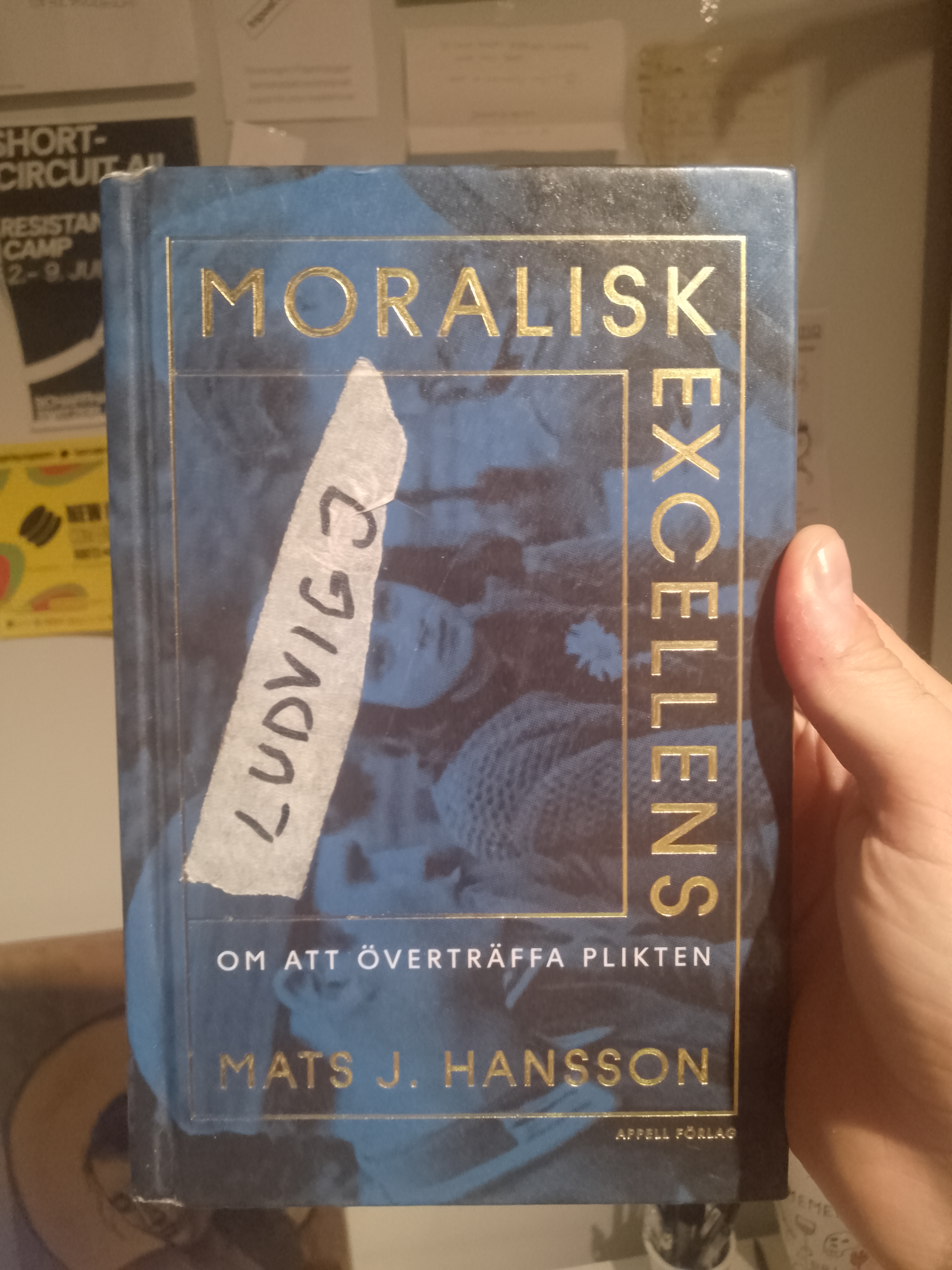
The City Library in Lund is a source of constant inspiration and knowledge for me. I don’t know who works there, but they always manage to pick out books that feel tailor-made for me. I picked this one up because it reminded me of certain interactions I’ve had as a climate activist. “Thank you for doing this; you’re so brave.” “Well, come and help us too, then.” Silence. What can I really expect from others?
“Ought implies can.” That is a phrase that appeared in the book. It means that if something is to be a requirement, it must, by definition, be feasible. But the argument went a step further. If we are to formulate norms that apply generally to society, then — according to the author, citing various philosophers — they must not demand too much. “Ought implies can (without great effort).” I found that statement fascinating. Finally, someone had clearly articulated something that I think many people think and live by, yet no one had ever said to me openly: “You cannot demand something of people that would require too much effort. If it involves effort or risk, it must remain voluntary.”
So, I shouldn’t be disappointed in people if they don’t change their consumption habits, don’t stop flying, or don’t get politically involved in limiting the damage caused by the climate crisis. While these would certainly be good things, because they are so demanding, we cannot have a general norm expecting everyone to make that sacrifice. While much of this resonates with me, we are still faced with a reality that demands sacrifices from us all. It is, of course, deeply frustrating that the natural world does not align with the kind of morality we find palatable. What do we do with that? A genuine question.
There is also a chapter titled “Too Good for One’s Own Good,” in which the author explores altruism. What about actions that might be viewed as doing a great deal of good in some “objective” sense, yet lack any personal connection to a recipient? Those of us who are wealthy could always donate far more money to war-torn countries; any comfort I allow myself could, in a way, be seen as coming at the expense of someone else’s right to life-sustaining resources.
And how does it work morally when, on the one hand, I want to do as much good as possible, yet on the other, I prioritize my family—despite claiming that everyone is of equal worth? Does this imply that there is no such thing as morality, only selfishness? Or can the two be reconciled?
The author looks at these questions from many, often surprising angles. It gave me a lot of food for thought. I recommend the book.
On another note, I’ve had an intense summer. I’m in a state of mind where I feel a lot is happening internally—yet again—and for that very reason, I’m finding it hard to write about it. But perhaps that will pass soon.