This is a translation of my article published in the swedish newspaper “Växjös Gnista”.
Moloch and us
Hi, my name is Ludvig, and I am a full-time climate activist. Call me naive, but I wish all people worked together for the common good, and I hate the fact that we don’t. It’s a pattern that comes up again and again - tax evasion, overfishing, arms races, or the climate crisis. People, companies, and states do things that give them a temporary advantage, but the effects are something that everyone fears: collapsing welfare, starvation, and nuclear bombs. Nobody wants a world with these things, but still we build it. What makes it so? Is there some invisible force that urges us humans to act this way? And if so - can we say anything about the nature of this force?
Let’s start with a side note. In the Old Testament, the word “Moloch” (“Molech”) is mentioned about eight times. Moloch seems to be an idol connected to child sacrifice, and in art history there are images of Moloch as a human figure with a bull’s head. In front of it burns a fire, and it stretches out its arms to receive the children who are sacrificed to it.
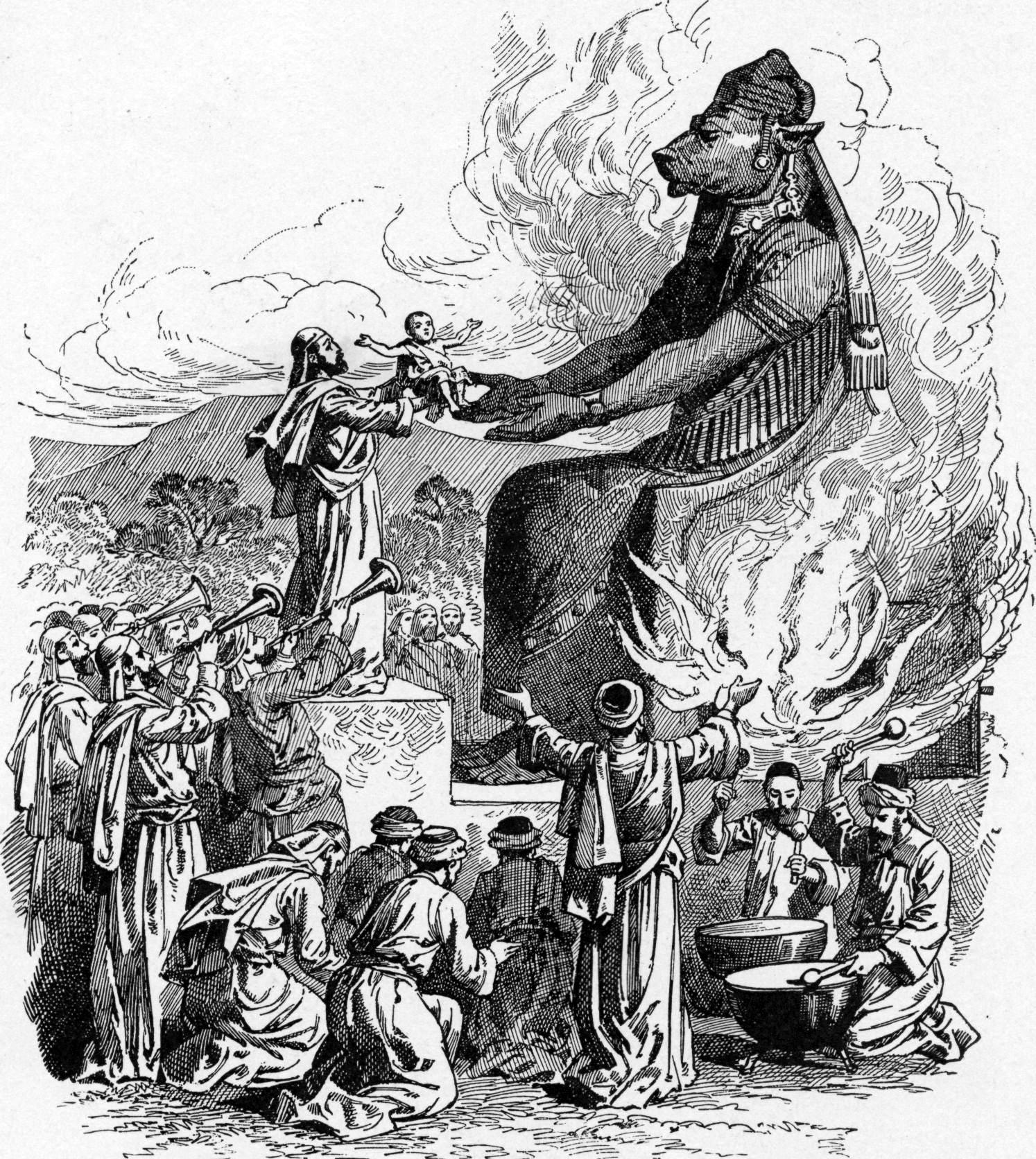
Now back to that force which seems to make us sabotage our whole existence. If you give something a name, it is easier to talk about it, and it so happens that some people have used “Moloch” as the name for this force or tendency. Moloch proclaims:
“If you don’t cut down the rainforest, sell the ammunition, or build the AI drones, someone else will certainly do it. They will become more powerful than you, and threaten you. So hurry up and do it first!”
We might metaphorically say that those who follow this logic are sacrificing their children to Moloch. A central part of the image for me is that they (we) are also victims themselves - Moloch has power over us. You don’t have to believe in supernatural beings, it’s just that if such a powerful idol ruled the world, it might not be so different from the world we have, where a swedish C++ programmer has to choose between building weapons at SAAB, fueling the climate crisis at Volvo, or constructing surveillance society at Palantir. Society offers me few options that don’t involve building a more horrible world, especially if I expect a high salary and status.
I stand here wanting to refuse, and what’s more - I want to stop this. I see that all of these options are wrong. But my resistance is fragile, ridiculous, naive, and futile. Who do I think I am, that I should be able to stand in the way of big business and billionaires? Me and what army? The climate movement sometimes feels like a bunch of teenagers and pensioners just chanting in a square. I know we are much more than that, but so what? We feel helpless against the unimaginable military, economic, and media power of fossil capitalism. The climate movement, as far as I know, has no plan that guarantees success. I am afraid, so afraid, of Moloch above us, and Moloch within us.
Yet I feel that I must resist. Something in my soul whispers: “You know the truth. You must act on it.” Fighting my fear and my doubts, on the days that I dare, I put myself in conflict with Moloch, in conflict with those who ally themselves with Moloch and those who ride on Moloch’s back. Those who die from Moloch actually beg me to stop resisting, because they are afraid. They fear that it will only get worse if you fight back. And they are not wrong - that is how the logic of power works. But I feel disappointed. Sophie Scholl was executed for defying Nazism, Maximiliam Kolbe sacrificed his life for a fellow prisoner in Auschwitz. We revere these heroes in our stories, but in the same breath refuse to apply their courage to what’s right in front of us.
There is a silver lining, but you’re not going to like it. Moloch’s days are numbered, at least in the form of global fossil capitalism. For you see, the enormous complexity that our societies exhibit is made possible only by enormous amounts of energy, a one-time charge that we consume at an ever-increasing rate. Our fossil-dependent global consumer society only keeps spinning as long as it has gas in the tank, but long before the oil runs out completely, it becomes more expensive. Already at that point, everything might collapse, due to its own complexity, which cannot adapt when the only irreplaceable resource, energy, can no longer be obtained in the same quantities. The fall of the global consumer civilization will mean immense suffering. Back in the 1970s, the authors of the “Limits to Growth” report understood that finite resources are just that, finite, and began to ask questions about what might happen when they run out. They have continued to release decade-by-decade reports that further illuminate this frightening reality.
Can we prepare ourselves somehow, can we soften the blow? Can we build resilient societies that better cope with a future disaster? When we ask these questions, we may be missing part of the point. Because the catastrophe is already here. Families are already being destroyed in wars and natural disasters. Or people are slowly suffering from housing shortages and segregation. Maybe “solidarity” can be understood as crisis management of a global crisis, if we understand not to close our eyes to others. If you can see time in a broader way, if you can see that a disaster can unfold over 50 years. Here I am afraid of being misunderstood – I am not talking about every mishap on Earth in some universal supernatural way. No, I am referring to a concrete physical pattern: land and soil, dignity and livelihood are destroyed in the service of growth, and when the energy then runs out after populations have grown, there is scarcity and war for resources, in a world that is deteriorated, and no longer able to feed us as it once could.
What do I wish from you? That you would want to make the suffering of others your own. I don’t believe in memorizing every ongoing struggle, or competing to see who is the most “aware”. You can start opposing Moloch in your own office: try to dare not to come first. To get paid less. To help someone else, to get rejected. Then raise your eyes and ask how you can make your resistance more systemic, how you can cut a little closer to the roots of evil. I don’t dare say that “if we all work together we can succeed”. I don’t want to give false hope. I just know that resisting is the right thing to do, in the way one can, and rejoicing along the way, perhaps even seeng joy as a duty. I wish that for you and for myself.
And as an addition, if you’re still reading: Leviticus describes what a solution to the Moloch problem, if any, would have to look like. It says something along the lines of: “the man who sacrifices to Moloch shall be punished with death, the people of the land shall stone him. If the people look on and let him sacrifice to Moloch, God will destroy both that man and the people”. The language is macabre, but the message I interpret is that the only way to rein in Moloch is for us to keep an eye on each other. It is not enough for me to refrain from burning the oil. We all need to agree to refrain, and what’s more, forcibly police each other, lest someone breaks the agreement to get ahead. Is this at all possible on a global level? If you don’t believe it, I won’t blame you, but I see here the only real chance for the survival of civilization.